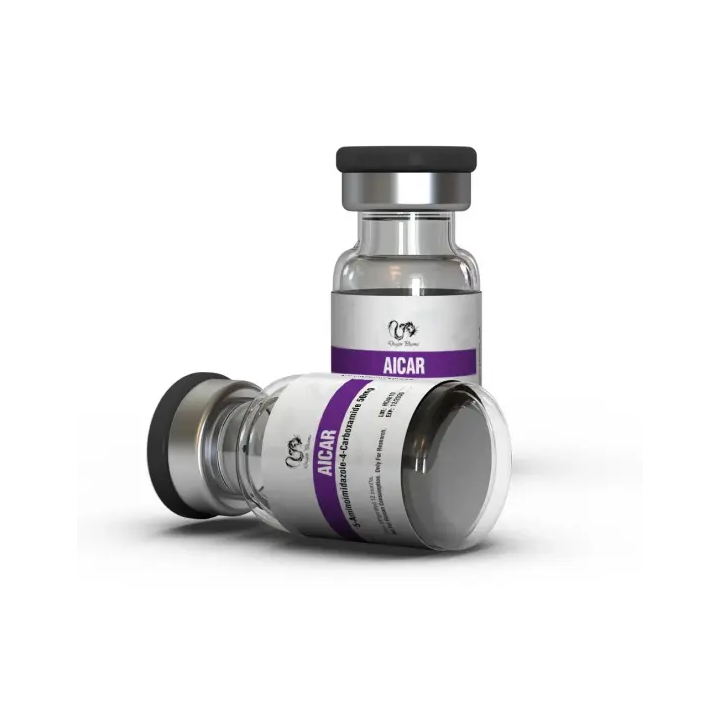
AICAR 50mg — Acadesine Nucleoside AMPK Activator by Dragon Pharma
AICAR (5-aminoimidazole-4-carboxamide ribonucleotide, Acadesine) is Dragon Pharma's formulation of the nucleoside analogue AMPK activator at 50mg per vial — a compound banned by WADA in 2011 precisely because its use in elite endurance sport was documented and its performance-enhancing mechanism is real. AICAR is not a peptide, not a SARM, and not a growth factor — it is a nucleoside analogue that enters cells and is phosphorylated to ZMP, which directly activates AMPK (AMP-activated protein kinase), the master cellular energy sensor that drives endurance adaptation, fat oxidation and mitochondrial biogenesis.
Also searched as: AICAR 50mg, Acadesine, AICAR AMPK, AICAR endurance, Acadesine Dragon Pharma.
What AICAR Is — Nucleoside Analogue, Not a Peptide
AICAR's chemical class is important for understanding how it works:
- AICAR (5-aminoimidazole-4-carboxamide-1-β-D-ribofuranoside) is a nucleoside analogue — a synthetic compound structurally related to adenosine, one of the four nucleoside building blocks of RNA and DNA
- It is not a peptide (no amino acid chain), not a steroid (no steroidal ring structure), not a SARM (no androgen receptor binding) and not a growth factor (no receptor for growth signalling)
- AICAR was originally developed as a cardioprotective agent for use during cardiac surgery — it was studied for its ability to protect heart tissue during ischemia (oxygen deprivation). Its AMPK-activating properties and metabolic effects were discovered as researchers explored its mechanism more deeply
- The compound gained attention in endurance sport when Bahr et al. and subsequent researchers demonstrated that AICAR administration in sedentary animals produced endurance adaptations similar to aerobic exercise training — without the training itself
The ZMP Mechanism — How AICAR Activates AMPK
The specific intracellular mechanism distinguishes AICAR from other AMPK activators:
- After injection, AICAR enters cells via adenosine transporters — the same membrane transporters that move adenosine across the cell membrane
- Inside the cell, AICAR is phosphorylated by adenosine kinase to form ZMP (5-aminoimidazole-4-carboxamide ribonucleotide monophosphate) — which accumulates intracellularly
- ZMP is a structural analogue of AMP (adenosine monophosphate) — it binds the AMP-sensing domain of AMPK and mimics the "low energy" signal that AMP itself sends when cellular energy charge is depleted (e.g. during intense exercise)
- This AMPK activation then triggers the full suite of downstream metabolic adaptations: increased fatty acid oxidation (more fat burned for energy), increased glucose uptake in muscle (GLUT-4 translocation), decreased gluconeogenesis in liver, mitochondrial biogenesis, and upregulation of genes involved in oxidative phosphorylation
- The key distinction from indirect AMPK activators: ZMP activates AMPK directly at the allosteric site — a more direct mechanism than compounds like metformin which activate AMPK indirectly through inhibition of Complex I of the mitochondrial electron transport chain
The WADA Ban — Why Elite Sport Banned AICAR in 2011
AICAR's anti-doping status reflects its documented real-world performance-enhancing use:
- WADA added AICAR (and GW501516/Cardarine) to the Prohibited List in 2011 under the category of "metabolic modulators" — a new category created specifically to address these non-hormonal performance-enhancing compounds
- The ban followed reports of AICAR use in professional cycling, where its endurance-enhancing effects without masking the hematological markers of EPO doping made it attractive to athletes wanting to avoid detection
- The documented competitive use provides a real-world validation of AICAR's endurance effects in trained humans — not just in sedentary rodents from laboratory studies
- AICAR is detectable in urine and blood tests through targeted metabolomic screening — its use in tested competition is not viable
The Landmark Animal Study — What Narkar et al. (Cell, 2008) Showed
The foundational AICAR exercise mimetic publication:
- Narkar et al. (Cell, 2008) — the same Salk Institute lab that investigated GW501516 — demonstrated that AICAR administration in sedentary mice increased running endurance by approximately 44% compared to controls, without any exercise training
- The endurance improvement was associated with increased expression of genes involved in fatty acid oxidation and mitochondrial biogenesis in skeletal muscle — confirming AMPK activation was driving transcriptional changes toward the trained phenotype
- The combination of AICAR + GW501516 (PPARδ agonist) produced an approximately 75% endurance improvement — demonstrating that AMPK and PPARδ pathways are synergistic, each amplifying the other's effects on oxidative metabolism genes
Effects and Benefits
- Direct AMPK activation via ZMP accumulation — the most pharmacologically direct AMPK activator available
- Endurance enhancement — approximately 44% improvement in sedentary animal models (Narkar et al.); documented use in elite human endurance sport
- Increased fatty acid oxidation — AMPK drives fat as the primary fuel source during sustained effort
- Mitochondrial biogenesis — AMPK activates PGC-1α, the master regulator of mitochondrial content
- Improved insulin sensitivity — AMPK drives GLUT-4 translocation in muscle independently of insulin
- No testosterone suppression — no PCT required
Dosage and Administration
| Protocol |
Dose |
Frequency |
Notes |
| Endurance / metabolic support |
50 mg/day |
Once daily injection |
Full vial per day; subcutaneous |
| Lower dose trial |
25 mg/day |
Once daily injection |
Half vial; assess response before full dose |
At 50mg per vial, full-dose protocols use one vial daily — a significant cost per day of use. Pre-workout injection 30-60 minutes before training is common practice to align AMPK activation with the exercise window. Reconstitute with bacteriostatic water. Store refrigerated at 2-8°C after reconstitution for up to 28 days. Cycle length is not firmly established — AICAR does not cause receptor desensitisation like beta-2 agonists, so continuous use is pharmacologically viable, though cost considerations typically drive cycling.


 Security policy
 Delivery policy
 Return policy
Comments (0)
Your review appreciation cannot be sent
Report comment
Report sent
Your report cannot be sent