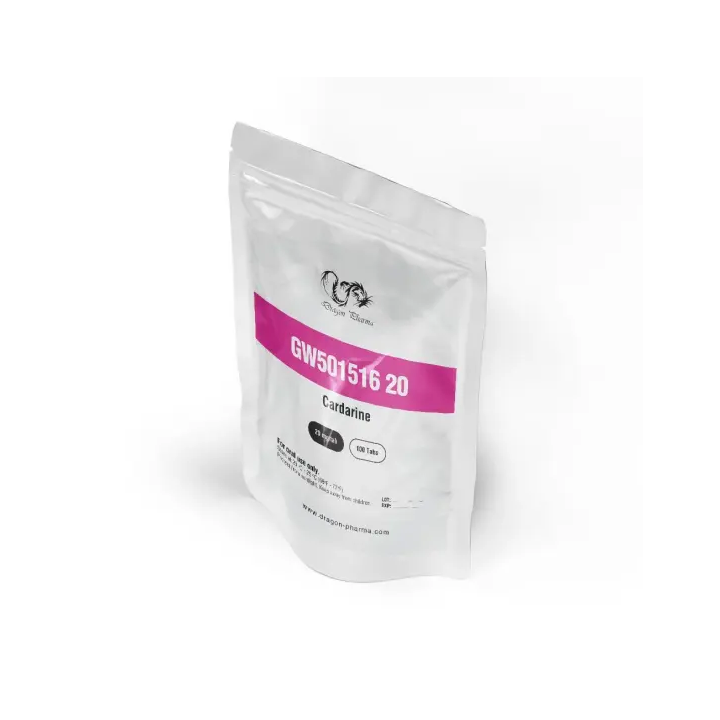
GW-501516 (Cardarine) 20mg by Dragon Pharma
GW-501516, commonly known as Cardarine, is Dragon Pharma's formulation at 20mg per tablet — a PPARδ (peroxisome proliferator-activated receptor delta) agonist that enhances fatty acid oxidation, endurance capacity and lipid metabolism. Supplied in a 100-tablet pack, GW-501516 is frequently and incorrectly classified as a SARM — it is not. Its mechanism is entirely different from androgen receptor modulators, and understanding this distinction is essential to understanding both its effects and its safety profile.
Also searched as: GW 501516, Cardarine 20mg, PPAR delta agonist, GW501516 Dragon Pharma.
GW-501516 Is Not a SARM — The Critical Misclassification
This is the most pervasive and consequential error in competitor content on this compound:
- SARMs (Selective Androgen Receptor Modulators) bind androgen receptors — the same receptors as testosterone and other anabolic steroids — with tissue-selective activity
- GW-501516 does not bind androgen receptors. It binds PPARδ (peroxisome proliferator-activated receptor delta) — a nuclear receptor that regulates fatty acid oxidation gene expression, mitochondrial biogenesis and metabolic switching
- GW-501516 has no anabolic activity, produces no testosterone suppression, does not require PCT, and does not produce any of the hormonal effects of SARMs or AAS
- Its mechanism — activating PPARδ to shift energy metabolism toward fat oxidation — is pharmacologically similar to the pathway activated by endurance exercise at the cellular level
- It is classified alongside SARMs in some contexts purely because it is commonly used by the same community and sold through the same channels — not because of any shared mechanism
The PPARδ Mechanism — How GW-501516 Actually Works
PPARδ is a nuclear receptor involved in regulating genes governing fatty acid oxidation and mitochondrial function. GW-501516's activation of PPARδ produces several downstream effects:
- Fatty acid oxidation upregulation: PPARδ activation increases expression of genes encoding enzymes involved in beta-oxidation — the cellular process of burning fatty acids for energy. The shift toward fat as a primary fuel source is similar to the metabolic adaptation seen in endurance-trained athletes
- Mitochondrial biogenesis: PPARδ activates PGC-1α co-activation — the same pathway stimulated by aerobic exercise — increasing mitochondrial density in skeletal muscle. More mitochondria per fibre = greater capacity for sustained aerobic energy production
- Muscle fibre type shift: Animal studies demonstrated a shift toward type I (slow-twitch, oxidative) muscle fibres with PPARδ activation — physically altering muscle composition toward endurance performance
- Endurance without training: The 2008 Narkar et al. study in Cell demonstrated that GW-501516 increased running endurance by 68% in untrained mice — generating significant media attention as a potential "exercise pill"
The Safety Question — Why GSK Discontinued Development
This is the most important safety information that competitor content almost universally omits or minimises:
- GlaxoSmithKline (GSK) developed GW-501516 in the 1990s-2000s for metabolic syndrome and dyslipidaemia indications
- In 2007, GSK halted all development of GW-501516 after animal toxicology studies showed rapid and widespread tumour development across multiple organ systems — in all animal species tested and at multiple dose levels
- The mechanism of concern: PPARδ activation may promote tumour proliferation and progression in pre-existing cancer cells. PPARδ plays a role in cell proliferation pathways, and its activation was found to accelerate cancer progression in models with pre-existing cancer
- Key distinction: GW-501516 does not appear to initiate cancer in healthy cells in all studies — the primary concern is its potential to accelerate existing tumour growth
- Human clinical data is very limited — the compound never progressed to Phase III trials. The safety picture in humans at the doses used in performance contexts is not established by rigorous clinical evidence
- WADA added GW-501516 to its prohibited list in 2009 specifically citing the cancer risk findings as a reason beyond doping concerns
Effects and Benefits
- Significant endurance enhancement — documented 68% increase in untrained mouse endurance; human reports consistent with meaningful aerobic capacity improvement
- Enhanced fatty acid oxidation — metabolic shift toward fat as primary fuel, improving body composition during caloric deficits
- Improved lipid profile — PPARδ activation associated with reduced LDL and triglycerides, increased HDL in animal studies
- No hormonal effects — no testosterone suppression, no estrogen effects, no PCT required
- Anti-catabolic during caloric deficit — fat oxidation shift preserves muscle glycogen, reducing catabolism of lean tissue
Dosage and Administration
| Protocol |
Dose |
Timing |
Duration |
| Standard endurance/fat loss |
10–20 mg/day |
Once daily (long half-life) |
4–8 weeks typically |
| Pre-workout timing |
20 mg |
1–2 hours before training |
As above |
With a ~16-24 hour half-life, once-daily dosing maintains stable blood levels. The 20mg tablet represents the higher end of commonly used doses — some users start at 10mg (half tablet) before escalating. GW-501516 does not require PCT and can be discontinued without a taper. It does not interact with androgen receptors or the HPG axis and can be used during AAS cycles or independently.


 Security policy
 Delivery policy
 Return policy
Comments (0)
Your review appreciation cannot be sent
Report comment
Report sent
Your report cannot be sent