
- -11%
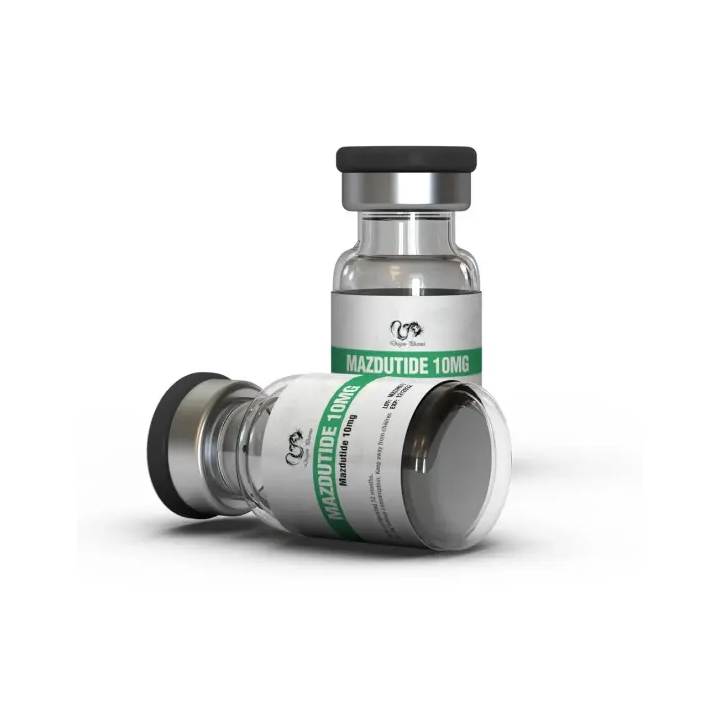
Mazdutide images
Mazdutide (also known by its research code IBI362 or OXM3) is Dragon Pharma's formulation of the once-weekly GLP-1/Glucagon dual agonist developed by Innovent Biologics in China. It is important to clarify a common misrepresentation: Mazdutide is a GLP-1/Glucagon dual agonist — not a GLP-1/GIP agonist as sometimes incorrectly described. Glucagon receptor agonism adds a mechanistically distinct third dimension to weight loss compared to GLP-1 alone, through hepatic fat mobilisation and thermogenic energy expenditure.
Also searched as: Mazdutide 10mg, IBI362, OXM3, GLP-1 glucagon dual agonist, Mazdutide Dragon Pharma.
This distinction matters mechanistically and should be understood before comparing Mazdutide to other weight loss peptides:
| Parameter | Mazdutide (GLP-1 + Glucagon) | Tirzepatide (GLP-1 + GIP) | Semaglutide (GLP-1 only) |
|---|---|---|---|
| Receptor targets | GLP-1R + Glucagon receptor (GCGR) | GLP-1R + GIP receptor (GIPR) | GLP-1R only |
| Appetite suppression | Via GLP-1R hypothalamic signalling | Via GLP-1R + GIP enhances GLP-1 effect | Via GLP-1R |
| Hepatic fat mobilisation | Yes — Glucagon directly drives hepatic lipolysis | Indirect — via GIP insulin-sensitising effects | Minimal direct |
| Thermogenesis | Yes — Glucagon directly increases energy expenditure | Some — via GIP brown fat activation | Minimal |
| Glucose management | GLP-1 manages glucose; Glucagon at normal doses does not impair glycaemia | Dual glucose-lowering | Primary glucose-lowering |
Glucagon is typically known as a counter-regulatory hormone to insulin — it raises blood glucose when glucose is low. However, in the context of a GLP-1/Glucagon dual agonist, Glucagon's metabolic effects produce specific fat-loss benefits that GLP-1 alone cannot achieve:
| Trial | Population | Dose | Weight Loss | Duration |
|---|---|---|---|---|
| GLORY-1 Phase III (2024) | Chinese obese adults (BMI ≥28) | 6 mg/week | ~14.0% body weight reduction | 48 weeks |
| Phase II dose-finding | Overweight/obese adults | 3–9 mg/week | 8–15% body weight reduction | 24 weeks |
| Hepatic steatosis sub-study | Obese adults with fatty liver | 6 mg/week | Significant hepatic fat reduction | 24 weeks |
The GLORY-1 Phase III trial (2024) represents Mazdutide's most rigorous efficacy data — ~14% body weight reduction over 48 weeks at 6mg/week. This positions Mazdutide between Semaglutide (~15% at 72 weeks) and Tirzepatide (~20% at 72 weeks) in efficacy, while offering the specific advantage of hepatic fat reduction that GLP-1 alone does not provide as directly.
| Compound | Mechanism | Clinical Weight Loss | Unique Advantage |
|---|---|---|---|
| Mazdutide | GLP-1 + Glucagon | ~14% over 48 weeks | Hepatic fat reduction; thermogenic expenditure |
| Tirzepatide | GLP-1 + GIP | ~20% over 72 weeks | Strongest Phase III weight loss data |
| Cagrilintide | Amylin analogue | ~11% standalone, ~23% + Sema | Area postrema mechanism; synergy with GLP-1 |
| AOD-9604 | GH fragment lipolysis | Modest standalone | No IGF-1 elevation; targeted fat oxidation |
| Phase | Dose | Frequency | Notes |
|---|---|---|---|
| Starting dose | 1–3 mg/week | Once weekly | Allow 4 weeks before escalation |
| Titration | 3–6 mg/week | Once weekly | Titrate every 4 weeks based on tolerance |
| Maintenance (Phase III) | 6 mg/week | Once weekly | 10mg vial provides ~1.5 doses at 6mg |
At 10mg per vial and 6mg/week maintenance dose, one vial provides approximately 1.5 weeks of dosing — users will need approximately 3 vials per month at maintenance. Reconstitute with bacteriostatic water. Unlike peptides requiring fasted dosing, Mazdutide's subcutaneous injection can be taken at any time of the week — consistency of day and time within the week is more important than meal timing.

 Security policy
 Delivery policy
 Return policy
Comments (0)
Your review appreciation cannot be sent
Report comment
Report sent
Your report cannot be sent