MOTS-c — Mitochondrial-Derived Metabolic Peptide by Dragon Pharma
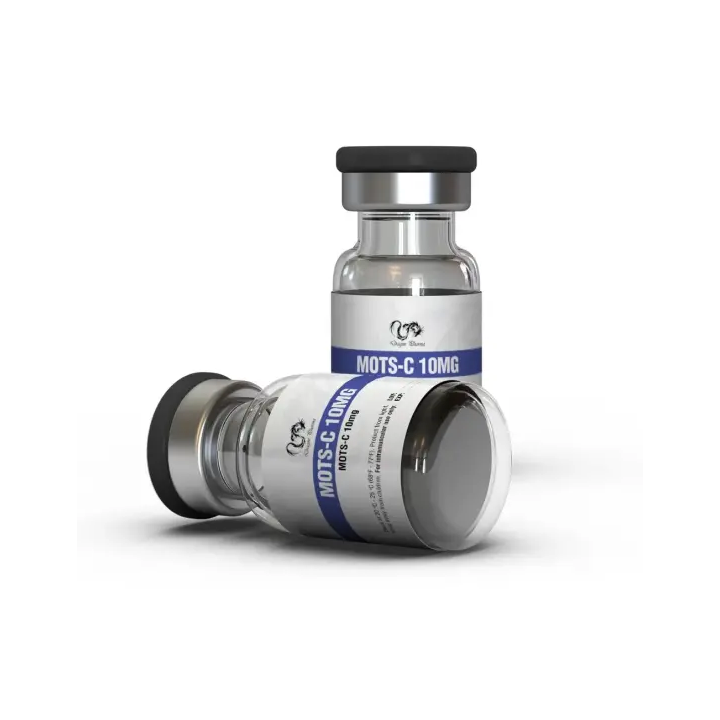
MOTS-c (Mitochondrial Open Reading Frame of the 12S rRNA type-c) is Dragon Pharma's formulation of the mitochondrial-derived peptide at 10mg per vial — a 16-amino acid peptide with a uniquely distinct origin from all other peptides in the range: it is encoded not by nuclear DNA but by the mitochondrial genome itself, specifically within the 12S rRNA gene of mitochondrial DNA. MOTS-c functions as a metabolic hormone that activates AMPK, improves insulin sensitivity and reproduces aspects of the metabolic adaptation to aerobic exercise — earning it classification as an "exercise mimetic."
Also searched as: MOTS-c 10mg, mitochondrial peptide, MOTS c AMPK, exercise mimetic peptide, MOTS-c Dragon Pharma.
What Makes MOTS-c Unique — Mitochondrial Genetic Origin
MOTS-c's origin is unlike any other peptide in the Dragon Pharma range — a genuine information gap that competitor content universally misses:
- Human cells contain two separate genomes: the nuclear genome (in the cell nucleus) encoding ~20,000 genes, and the mitochondrial genome (in each mitochondrion) encoding only 37 genes — 13 proteins, 22 tRNAs and 2 rRNAs
- MOTS-c was discovered in 2015 by Lee et al. (Cell Metabolism) as a peptide encoded within the 12S rRNA gene of mitochondrial DNA — a region not previously recognised as protein-coding. This was a landmark discovery as it identified a new class of biologically active peptides from mitochondrial DNA
- The mitochondrial origin has functional significance: MOTS-c is produced by mitochondria themselves and acts as a retrograde signal — communicating the metabolic status of mitochondria to the rest of the cell and to the systemic circulation. MOTS-c plasma levels rise during exercise, decline with aging and increase in response to metabolic stress
- This makes MOTS-c a physiological exercise response signal — not a pharmacological intervention targeting a receptor, but a natural mitochondrial communication peptide that exercise induces and aging depletes
The AMPK Mechanism — How MOTS-c Works
MOTS-c's primary metabolic effect is mediated through AMPK (AMP-activated protein kinase) — the master energy sensor of the cell:
- MOTS-c activates AMPK in skeletal muscle, liver and adipose tissue. AMPK is the same pathway activated by metformin (the diabetes drug) and by aerobic exercise — it signals a low-energy state and triggers compensatory metabolic adaptations
- AMPK activation by MOTS-c produces: increased fatty acid oxidation (more fat burned for energy), increased glucose uptake in muscle (via GLUT-4 translocation, without requiring insulin), decreased gluconeogenesis in the liver (less new glucose production), and mitochondrial biogenesis (more mitochondria per cell)
- A specific mechanism discovered in the original MOTS-c paper: MOTS-c interferes with the folate cycle — specifically inhibiting the AICAR-transformylase step. This generates AICAR (5-aminoimidazole-4-carboxamide ribonucleotide), which is an endogenous AMPK activator. AICAR itself is sold as Acadesine (AICAR) and produces overlapping but distinct effects to MOTS-c
MOTS-c as an Exercise Mimetic
The term "exercise mimetic" refers to compounds that pharmacologically reproduce some metabolic adaptations of exercise without requiring physical activity itself:
- During aerobic exercise, MOTS-c plasma levels rise — it is one of the exercise-responsive signalling molecules that mediates the systemic metabolic benefits of physical activity
- Exogenous MOTS-c injection reproduces several acute exercise-like metabolic shifts: increased glucose utilisation in muscle, improved insulin sensitivity, AMPK activation, and mitochondrial adaptation signals
- The original 2015 Cell Metabolism paper by Lee et al. demonstrated that MOTS-c injection in mice prevented diet-induced obesity and improved insulin sensitivity — effects that parallel the metabolic benefits of regular exercise training
- In aged mice, MOTS-c administration improved physical performance and muscle function — with subsequent human data (Lee et al., 2019) showing that MOTS-c levels are significantly lower in older adults and that this decline correlates with reduced metabolic health markers
MOTS-c and Aging — The Longevity Connection
| Finding |
Source |
Significance |
| MOTS-c plasma levels decline significantly with age |
Lee et al., 2019 |
Declining MOTS-c may contribute to age-related metabolic deterioration |
| MOTS-c injection improves insulin sensitivity in aged mice |
Lee et al., 2015 (Cell Metabolism) |
Exogenous MOTS-c partially restores youthful metabolic function |
| MOTS-c administration improves grip strength and exercise capacity in aged mice |
Reynolds et al., 2021 |
Physical performance effects beyond metabolic parameters |
| MOTS-c variants associated with human longevity in centenarian studies |
Zempo et al., 2021 |
Specific MOTS-c genetic variants correlate with exceptional longevity |
Effects and Benefits
- AMPK activation — the central metabolic effect, producing downstream improvements in glucose utilisation, fat oxidation and mitochondrial function
- Improved insulin sensitivity — increased non-insulin-dependent glucose uptake in skeletal muscle via GLUT-4 translocation
- Exercise-mimetic metabolic adaptation — activates some of the same pathways as aerobic training without physical activity
- Anti-obesity effect in animal models — prevents diet-induced obesity when combined with appropriate nutrition
- Physical performance support in aged subjects — animal data showing improved exercise capacity
- No testosterone suppression — no PCT required
Dosage and Administration
| Protocol |
Dose |
Frequency |
Notes |
| Metabolic support / insulin sensitivity |
5–10 mg/week |
1–2× weekly or daily low-dose |
No established optimal human protocol; animal data guides current use |
| Performance / longevity |
5–10 mg/week |
1–2× weekly |
Subcutaneous injection; timing relative to exercise flexible |
At 10mg per vial, a 5mg/week protocol provides 2 weeks per vial; a 10mg/week protocol uses one vial weekly. Human dosing for MOTS-c is not established by clinical trials — protocols are extrapolated from animal studies and early human pharmacokinetic data. Reconstitute with bacteriostatic water. Store refrigerated at 2-8°C after reconstitution for up to 28 days. Injection timing relative to exercise is flexible — unlike some GH peptides, there is no compelling evidence that fasted or post-workout timing is critical.


 Security policy
 Delivery policy
 Return policy
Comments (0)
Your review appreciation cannot be sent
Report comment
Report sent
Your report cannot be sent