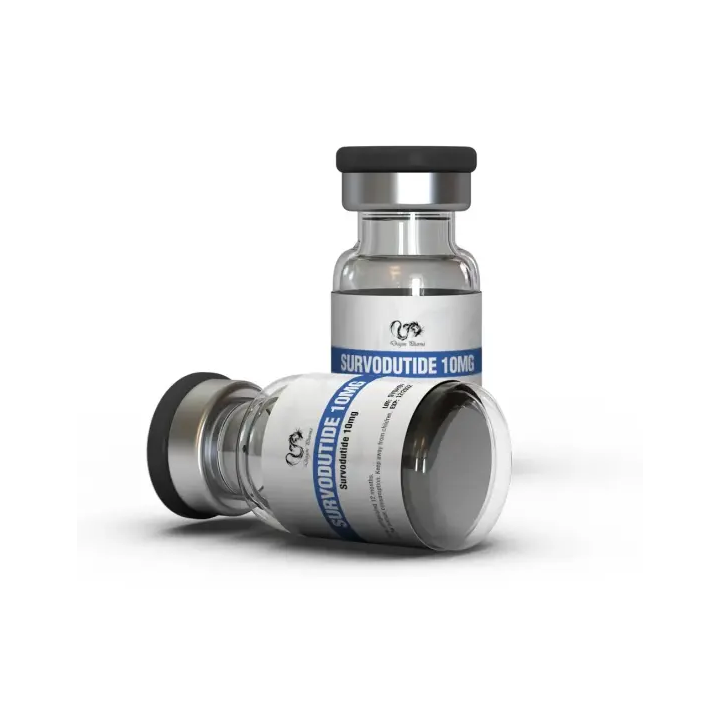
Survodutide

Regular price: $105.00 (Save 11%)
Price: $93.45

Survodutide

GLP-1 / Glucagon Dual Agonistβ€’10 mg vial
Class GLP-1 / Glucagon Dual Agonist
Developer Boehringer Ingelheim
Half-Life ~1 week (once-weekly)
Suppression None (HPG)
Reconstitution Bacteriostatic Water
Form Subcutaneous Vial

Share

Survodutide β€” GLP-1/Glucagon Dual Agonist by Dragon Pharma

Survodutide (BI 456906) is Dragon Pharma's formulation of Boehringer Ingelheim's once-weekly GLP-1/Glucagon dual agonist at 10mg per vial β€” the Western pharmaceutical counterpart to Mazdutide in the GLP-1+Glucagon category, developed by one of the world's largest pharmaceutical companies with a clinical programme spanning both obesity and liver disease. Survodutide shares the GLP-1/Glucagon dual mechanism with Mazdutide but has distinct clinical data, particularly from its Phase II NASH programme β€” the most specific liver disease data of any compound in the Dragon Pharma weight management range.

Also searched as: Survodutide, BI 456906, Boehringer Ingelheim GLP-1 glucagon, Survodutide weight loss, Survodutide Dragon Pharma.

What Survodutide Is β€” Boehringer Ingelheim's GLP-1/Glucagon Agonist

Understanding Survodutide's developer and development context distinguishes it from other compounds in this category:

  • Survodutide (internal code BI 456906) was developed by Boehringer Ingelheim β€” a privately held German pharmaceutical company and one of the world's 20 largest by revenue. This is a significantly different development context from Mazdutide (Innovent Biologics, China) and from the research peptide origins of most other compounds in this range
  • Boehringer Ingelheim has a specific strategic focus on metabolic disease and liver conditions β€” the Survodutide programme reflects this, with parallel clinical development arms for obesity and non-alcoholic steatohepatitis (NASH/MAFLD)
  • Survodutide uses a fatty acid conjugation approach for albumin binding β€” the same mechanism that extends Semaglutide's half-life to ~7 days β€” producing the once-weekly dosing profile
  • Like all GLP-1/Glucagon dual agonists, Survodutide balances the appetite-suppressing, gastric-emptying-slowing effects of GLP-1R activation with the hepatic lipolysis and thermogenic energy expenditure effects of glucagon receptor activation

The NASH Clinical Programme β€” Survodutide's Specific Liver Data

This is Survodutide's most distinct clinical feature compared to other GLP-1+Glucagon compounds:

  • Non-alcoholic steatohepatitis (NASH, now more commonly termed MASH β€” Metabolic dysfunction-Associated SteatoHepatitis) is a progressive liver disease involving inflammation and fibrosis on top of fatty liver β€” a condition with no approved treatments until very recently
  • Boehringer Ingelheim conducted a dedicated Phase II trial of Survodutide in NASH/MASH patients β€” reporting results in 2023-2024 that showed significant improvements in liver histology (biopsy-confirmed reduction in inflammation and fibrosis) in a meaningful proportion of patients
  • The liver fibrosis resolution rate from Survodutide's NASH Phase II provides a specific and measurable endpoint beyond body weight reduction β€” making it the compound with the most specific liver disease clinical data in the Dragon Pharma weight management range
  • For AAS users specifically: AAS use β€” particularly oral 17-AA compounds and higher-dose injectable protocols β€” is associated with liver stress, elevated liver enzymes and in some cases NAFLD (non-alcoholic fatty liver disease). Survodutide's documented liver fibrosis reduction mechanism is directly relevant to this population

Survodutide Clinical Weight Loss Data

Trial Population Dose Weight Loss Duration
Phase II (obesity, 2023) Adults with obesity (BMI β‰₯30 or β‰₯27 with comorbidity) 2.4–4.8 mg/week ~14.9% body weight at highest dose 46 weeks
Phase II (NASH, 2023–2024) Adults with biopsy-confirmed NASH Various Significant hepatic fat and fibrosis reduction alongside weight loss 48 weeks

Survodutide vs Mazdutide β€” The GLP-1/Glucagon Comparison

Both are GLP-1/Glucagon dual agonists β€” the key distinctions are developer, clinical programme focus and regulatory trajectory:

Parameter Survodutide (BI 456906) Mazdutide (IBI362/OXM3)
Developer Boehringer Ingelheim (Germany) Innovent Biologics (China)
Mechanism GLP-1R + Glucagon receptor GLP-1R + Glucagon receptor
Phase III obesity data In progress (2024-2025) GLORY-1: ~14% weight loss at 48 weeks
NASH/liver disease programme Yes β€” Phase II histology data available Hepatic fat reduction β€” less specific NASH data
Western regulatory pathway Active β€” Boehringer Ingelheim pursuing EMA/FDA Chinese NDA pathway primarily
Phase II weight loss ~14.9% at 46 weeks (highest dose) ~15.6% at 32 weeks (Phase II)
Primary differentiator NASH/liver fibrosis clinical data; Western pharma development Phase III obesity RCT completed

The GLP-1/Glucagon Mechanism β€” Why It Matters

As with Mazdutide, understanding why Glucagon adds something GLP-1 alone cannot is essential:

  • GLP-1 receptor activation: appetite suppression via hypothalamic signalling, gastric emptying delay, insulin secretagogue
  • Glucagon receptor activation: direct hepatic lipolysis (triglyceride breakdown in liver), increased thermogenic energy expenditure, fatty acid oxidation upregulation β€” the mechanisms specifically relevant for liver fat reduction
  • The GLP-1 component partially counteracts the hyperglycaemic effect of glucagon at therapeutic doses β€” producing the net glucose-neutral or mildly glucose-lowering combined effect that makes the combination clinically viable

Effects and Benefits

  • ~14.9% body weight reduction over 46 weeks at highest Phase II dose
  • Specific liver fibrosis and NASH improvement data β€” biopsy-confirmed histological benefit in Phase II NASH trial
  • Direct hepatic lipolysis from glucagon receptor component β€” liver fat reduction alongside body weight reduction
  • Increased thermogenic energy expenditure from glucagon receptor signalling
  • No testosterone suppression β€” no PCT required
  • Once-weekly dosing from the ~1-week half-life

Dosage and Administration

Phase Dose Frequency Notes
Starting 0.6–1.2 mg/week Once weekly Allow 4 weeks before escalation; assess GI tolerance
Titration 2.4 mg/week Once weekly Main Phase II dose β€” most weight loss data at this level
Higher dose 4.8 mg/week Once weekly Highest Phase II dose β€” ~14.9% weight loss; more GI side effects

At 10mg per vial, a 2.4mg/week protocol provides approximately 4 doses per vial. Reconstitute with bacteriostatic water. Store reconstituted vial refrigerated at 2-8Β°C for up to 28 days. Once-weekly injection can be taken at any time β€” consistency of day matters more than meal timing.

  • Brand
Security policy
(edit with the Customer Reassurance module)
Delivery policy
(edit with the Customer Reassurance module)
Return policy
(edit with the Customer Reassurance module)

Comments (0)

No customer reviews for the moment.

4 other products in the same category

  • -11%
AOD 9604 5mg
$52.51
$59.00
Rated out of 5 stars based on review(s)
  • -11%
  • New
Winstrol 10
$41.83
$47.00
Rated out of 5 stars based on review(s)
  • -11%
  • New
Deca 200 / NPP 150
$97.01
$109.00
Rated out of 5 stars based on review(s)
  • On sale!
  • -11%
  • New
Oxymetholon
$105.91
$119.00
Rated out of 5 stars based on review(s)

Viewed products

  • -11%
  • New
EQ 300
$52.51
$59.00
Rated out of 5 stars based on review(s)
  • -11%
  • New
PT-141
$41.83
$47.00
Rated out of 5 stars based on review(s)
  • On sale!
  • -18%
  • New
Deca 500
$72.16
$88.00
Rated out of 5 stars based on review(s)
  • -11%
  • New
SLU-PP-332
$61.41
$69.00
Rated out of 5 stars based on review(s)
Loading...
Back to top