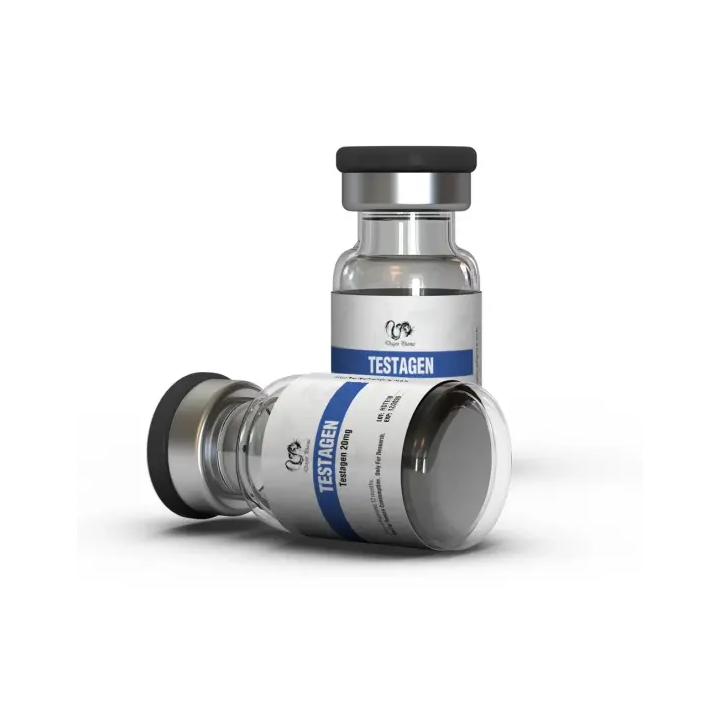
Testagen — Testicular Bioregulator Tetrapeptide by Dragon Pharma
Testagen (Lys-Glu-Asp-Gly) is Dragon Pharma's formulation of the testicular Khavinson bioregulator tetrapeptide at 20mg per vial — the male reproductive system-targeted peptide in the Khavinson bioregulator series developed at the St. Petersburg Institute of Bioregulation and Gerontology. Like Ovagen (liver bioregulator) and Livagen (immune bioregulator), Testagen works through epigenetic DNA demethylation in its target tissue — in this case, testicular Leydig cells and Sertoli cells — potentially reactivating gene expression programmes suppressed by aging or AAS-induced testicular atrophy.
Also searched as: Testagen peptide, Lys-Glu-Asp-Gly bioregulator, Testagen testicular, Khavinson male bioregulator, Testagen Dragon Pharma.
Testagen in the Khavinson Framework — Testicular Tissue Specificity
Understanding Testagen requires the same Khavinson bioregulator framework as Ovagen and Livagen:
- The Khavinson bioregulator series assigns each peptide to a specific tissue origin — Testagen is derived from testicular tissue extract. The peptide Lys-Glu-Asp-Gly was isolated and identified as a regulatory signal present in testicular tissue, acting preferentially on testicular cells when administered
- The testes contain two functionally distinct cell populations relevant to Testagen: Leydig cells (interstitial cells that produce testosterone in response to LH) and Sertoli cells (which support sperm maturation in response to FSH)
- Both cell types show age-related functional decline and epigenetic changes — Leydig cell testosterone output per cell declines with age; Sertoli cell number and function decrease, reducing spermatogenic support capacity
- Testagen's proposed mechanism: direct interaction with chromatin in testicular cells, promoting DNA demethylation of gene promoters silenced by aging or functional suppression — potentially restoring the gene expression programmes of younger, more functional testicular cells
The AAS-Specific Mechanism — Leydig Cell Atrophy
Testagen's most specific and most underexplained application for AAS users:
- AAS suppress LH production through HPG axis negative feedback — without LH stimulation, Leydig cells receive no signal to produce testosterone. Extended LH deprivation causes Leydig cells to undergo functional atrophy: they reduce in size, reduce steroidogenic enzyme expression, and become less responsive to LH stimulation even when natural LH production resumes post-cycle
- This Leydig cell atrophy is the primary reason post-AAS testosterone recovery can be slow and incomplete — even when LH returns to baseline levels, the Leydig cells may not respond adequately because their gene expression machinery has been downregulated
- HCG (LH mimetic) addresses this at the receptor level — stimulating LH receptors to maintain Leydig cell activity during cycles. But HCG works downstream of gene expression — it provides the signal, but if the Leydig cells' steroidogenic gene expression has been epigenetically downregulated, the response to that signal is blunted
- Testagen theoretically addresses this at the epigenetic level — reactivating the steroidogenic gene expression in Leydig cells that LH deprivation has silenced. In this model, Testagen and HCG are complementary: HCG provides the stimulatory signal; Testagen ensures the receiving machinery (steroidogenic gene expression in Leydig cells) is restored to full capacity
Testagen vs HCG vs SERMs — Testicular Recovery Comparison
| Agent |
Level of Action |
Mechanism |
What It Cannot Do |
| Testagen |
Leydig / Sertoli cell epigenome |
DNA demethylation → gene reactivation in testicular cells |
Does not stimulate testosterone production directly; no LH mimicry |
| HCG |
LH receptor on Leydig cells |
LH mimetic → stimulates testosterone synthesis |
Does not reactivate epigenetically silenced steroidogenic genes |
| Clomid / Nolvadex |
Hypothalamus / Pituitary |
ER blockade → restored LH/FSH production |
Cannot directly restore Leydig cell gene expression capacity |
| Kisspeptin |
Hypothalamus (above GnRH) |
GPR54 stimulation → pulsatile GnRH release |
Acts at top of axis; cannot restore Leydig cell function directly |
Testagen in the Complete Khavinson Bioregulator Stack
Testagen completes the primary tissue-targeted Khavinson bioregulators available in the Dragon Pharma range:
- Epitalon — pineal gland bioregulator; systemic anti-aging via telomerase activation and melatonin restoration
- Livagen — immune/lymphoid bioregulator; epigenetic gene reactivation in lymphoid tissue
- Ovagen — liver/GI bioregulator; epigenetic gene reactivation in hepatocytes and GI mucosa
- Testagen — testicular bioregulator; epigenetic gene reactivation in Leydig and Sertoli cells
Used together, these four bioregulators provide Khavinson's multi-tissue epigenetic restoration approach — each targeting a different organ system's gene expression decline with aging or functional suppression.
Effects and Benefits
- Leydig cell gene expression restoration — reactivation of steroidogenic gene programmes silenced by LH deprivation and aging
- Sertoli cell functional support — gene expression restoration in spermatogenesis-supporting cells
- Post-AAS testicular recovery support — complementary to HCG and SERM approaches, operating at the epigenetic rather than receptor level
- Age-related hypogonadism support — age-associated Leydig cell functional decline is an epigenetic as well as hormonal phenomenon
- No testosterone suppression — Testagen does not add exogenous hormones or suppress natural production
- No PCT required after Testagen itself
Dosage and Administration
| Protocol |
Dose |
Frequency |
Duration |
| Post-cycle testicular recovery |
100–200 mcg |
Daily |
10–20 day course during or after PCT |
| Age-related testicular support |
100–200 mcg |
Daily |
10–20 day course, 1-2× yearly |
At 20mg per vial and 200mcg per dose, one vial provides 100 doses — multiple annual courses. Following the Khavinson course-based approach (10-20 day intensive protocols) rather than continuous use is standard for this class of bioregulators. Testagen is most logically used during or immediately after PCT, when the goal is maximising testicular functional recovery alongside the HPG axis restoration that SERMs and HCG provide. Reconstitute with bacteriostatic water. Store reconstituted vial refrigerated at 2-8°C for up to 28 days.



 Security policy
 Delivery policy
 Return policy
Comments (0)
Your review appreciation cannot be sent
Report comment
Report sent
Your report cannot be sent