YK-11 — Steroidal Myostatin Inhibitor / Partial AR Agonist by Dragon Pharma
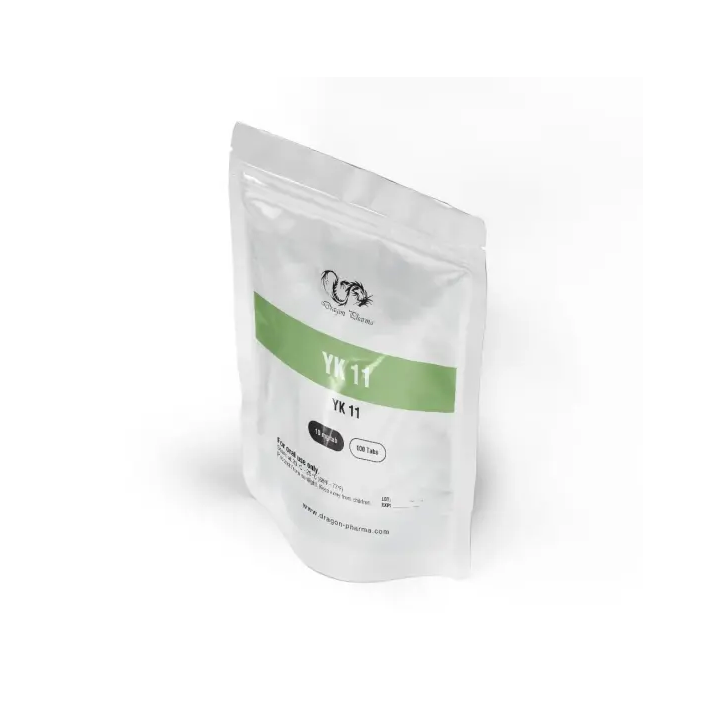
YK-11 is Dragon Pharma's formulation of the most pharmacologically unique compound in the SARM category at 10mg per tablet — a steroidal partial androgen receptor agonist that simultaneously upregulates Follistatin to inhibit myostatin, combining two distinct anabolic mechanisms in one molecule. The "SARM" label applied to YK-11 is a simplification: unlike all other SARMs in this range (Ostarine, LGD-4033, S23, GW-501516, SLU-PP-332), which are non-steroidal synthetic ligands, YK-11 is a synthetic steroid structurally derived from 5α-dihydrotestosterone (DHT) — with a unique C17 ester that confers oral bioavailability and the partial AR agonist + Follistatin induction profile that distinguishes it from any other compound in performance use. Its evidence base is currently limited to in vitro cell culture studies — no published animal or human pharmacokinetic data exists.
Also searched as: YK-11 10mg, YK11 myostatin inhibitor, YK-11 SARM, YK 11 Dragon Pharma, Follistatin inducer.
Why YK-11 Is Not a Conventional SARM — The Structural Reality
This distinction is the most consistently omitted fact in YK-11 content:
- Conventional SARMs (Selective Androgen Receptor Modulators) are non-steroidal synthetic compounds — they were designed specifically to bind androgen receptors with a non-steroidal scaffold, aiming to separate anabolic effects (muscle, bone) from androgenic effects (prostate, scalp). Ostarine, LGD-4033, S23 and RAD-140 are all non-steroidal small molecules
- YK-11 is a synthetic steroid — it shares a steroidal four-ring backbone with DHT, with modifications that make it orally active and create its partial AR agonist profile. Specifically, YK-11 is a C17-methyl-C21-ester derivative of 19-nor-DHT (structurally closer to nandrolone metabolites than to conventional SARMs)
- This steroidal structure has important implications: unlike non-steroidal SARMs which are metabolised by non-steroidal pathways, YK-11's metabolism may follow steroidal metabolic pathways with potentially different hepatic and endocrine consequences than non-steroidal SARMs
- The "SARM" designation persists in the performance community because YK-11 demonstrates some tissue selectivity — partial AR agonism rather than full agonism — but it is more accurately described as a synthetic steroidal partial androgen receptor agonist with Follistatin-inducing properties
The Dual Mechanism — AR Partial Agonism and Follistatin Induction
YK-11's anabolic potential derives from two distinct mechanisms operating simultaneously:
- Partial AR Agonism: YK-11 binds the androgen receptor but activates only a subset of the receptor's downstream signalling compared to full agonists like DHT or testosterone. The partial agonism produces anabolic gene expression in muscle tissue — protein synthesis, satellite cell activation — while potentially producing less complete androgenic effects than a full AR agonist. In practice at higher doses, the distinction from full agonism becomes less clear
- Follistatin Induction (Myostatin Inhibition): Myostatin (GDF-8) is a TGF-β family protein that functions as a negative regulator of skeletal muscle mass — it limits muscle growth as a biological ceiling. Follistatin is the endogenous antagonist of myostatin — it binds and inactivates myostatin, removing the growth ceiling. YK-11 was shown in cell culture (Kanno et al., 2013, Biology of Chemistry) to significantly upregulate Follistatin expression in C2C12 myoblasts — the muscle precursor cell line. By inducing Follistatin production, YK-11 indirectly inhibits myostatin, theoretically removing or raising the genetic ceiling on muscle mass
- The combination of direct AR activation (muscle protein synthesis) plus Follistatin-mediated myostatin inhibition (removing the growth ceiling) gives YK-11 its theoretical superposition of anabolic mechanisms that no other SARM or conventional AAS provides simultaneously
The Evidence Gap — Critical Context
This is the most important section for any user considering YK-11:
- YK-11's entire published scientific evidence base consists of in vitro studies only — specifically Kanno et al. (2013) demonstrating AR binding, partial agonism and Follistatin induction in cultured cell lines. No published peer-reviewed animal pharmacokinetic data exists. No human trials have been conducted or published
- In vitro results in cell culture do not reliably predict in vivo pharmacokinetics, bioavailability, metabolism, tissue distribution or safety. The Follistatin induction observed in C2C12 cells may or may not translate to meaningful Follistatin elevation in living skeletal muscle — which operates in a very different biochemical environment than cell culture
- This places YK-11 in a categorically different evidence tier from even preclinical-only SARMs like S23 (which has rodent in vivo data) — YK-11's in vivo behaviour is essentially uncharacterised in published literature
- Community use and anecdotal reports provide the only practical performance data — which consistently suggest significant anabolic effects and significant HPG suppression, but are not peer-reviewed and cannot characterise safety with the reliability of controlled studies
YK-11 in the Full SARM/Research Compound Hierarchy
| Compound |
Structure |
Mechanism |
Evidence Level |
HPG Suppression |
| Ostarine |
Non-steroidal |
Partial AR agonist |
Phase III human trials |
Mild |
| LGD-4033 |
Non-steroidal |
Full AR agonist |
Phase I human trial |
Significant |
| S23 |
Non-steroidal |
Full AR agonist |
Rodent in vivo |
High to complete |
| YK-11 |
Steroidal (DHT-derived) |
Partial AR agonist + Follistatin induction |
In vitro only |
Significant (anecdotal) |
Effects and Benefits
- Dual anabolic mechanism — AR activation plus Follistatin-mediated myostatin inhibition; theoretically the most comprehensive anabolic signalling available from a single oral compound
- Lean mass gains — consistent with significant AR agonism; community reports suggest LGD-4033-comparable or superior lean mass accumulation
- Strength gains — significant; reported as one of YK-11's most prominent effects
- Muscle fullness and density — consistent with both AR and anti-myostatin mechanism activity
- No aromatisation — steroidal but no estrogenic conversion at typical doses
Dosage and Administration
| Experience Level |
Daily Dose |
Cycle Length |
PCT |
| First YK-11 cycle |
5–10 mg/day |
6 weeks |
Full PCT — mandatory |
| Experienced |
10–15 mg/day |
6–8 weeks |
Full PCT; HCG advisable |
The ~6-10 hour half-life requires twice-daily dosing for stable blood levels — split morning and evening. Given the steroidal structure and significant suppression reports, hepatic monitoring (ALT/AST) is advisable at higher doses — unlike non-steroidal SARMs, YK-11's steroidal scaffold may have hepatic metabolism consequences that are not fully characterised. PCT with Clomid or Nolvadex is mandatory; begin 24-48 hours after the last tablet.


 Security policy
 Delivery policy
 Return policy
Comments (0)
Your review appreciation cannot be sent
Report comment
Report sent
Your report cannot be sent