
- -11%
- New
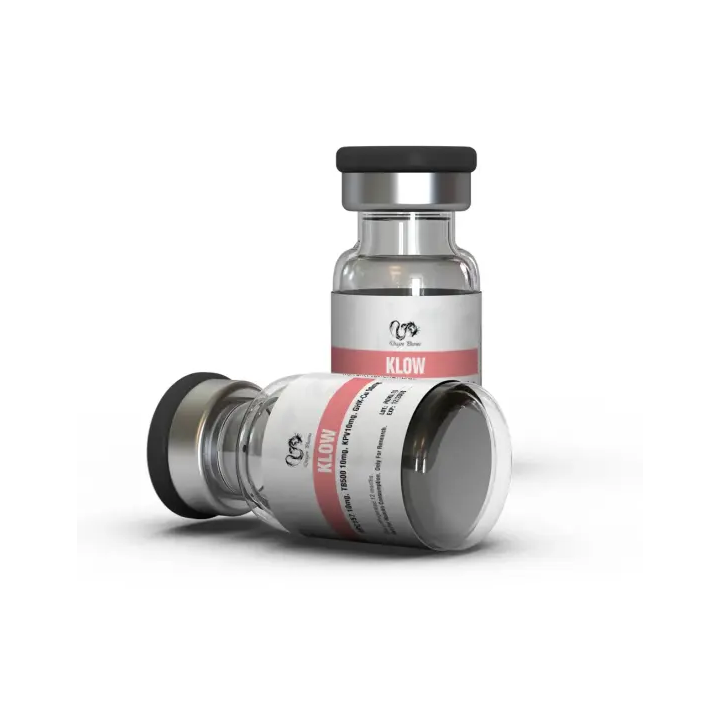
Klow Blend images
Klow Blend is Dragon Pharma's advanced 4-peptide formulation combining BPC-157, TB-500, KPV and GHK-Cu in a single 80mg vial. Each component works through a distinct mechanism — localised tissue repair, systemic recovery, immune modulation and collagen-driven skin regeneration — covering a broader spectrum of recovery and repair than any single peptide or two-component blend can achieve.
Also searched as: Klow Blend 80mg, BPC-157 TB-500 KPV GHK-Cu blend, 4-peptide recovery blend, Klow Blend Dragon Pharma.
Understanding why these four peptides are combined requires understanding what each one does and — critically — what the others cannot:
| Peptide | Mechanism | Primary Role in Blend | Unique Contribution |
|---|---|---|---|
| BPC-157 | Upregulates growth hormone receptors; promotes angiogenesis and VEGF activity | Localised tendon, ligament and gut repair | Most effective near the injury site; the only component with documented gut-protective properties |
| TB-500 | Thymosin Beta-4 fragment; promotes actin polymerisation and cell migration to damaged tissue | Systemic tissue repair and anti-inflammation | Works systemically regardless of injection site; reaches injuries BPC-157 cannot when site injection isn't practical |
| KPV | Alpha-MSH-derived tripeptide; binds MC1R and MC3R receptors; reduces NF-κB pathway activation | Anti-inflammatory and immune modulation | The only component specifically targeting immune-driven inflammation; addresses gut and skin inflammation through a different pathway than BPC-157 |
| GHK-Cu | Copper tripeptide; upregulates collagen, elastin and glycosaminoglycan synthesis; activates TGF-β | Skin regeneration and collagen repair | The only component with documented effects on skin quality and hair growth; functions at concentrations as low as 1 nanomolar |
Most peptide blends combine compounds from the same functional category — BPC-157 + TB-500 is a local + systemic pairing within the same tissue repair category. Klow Blend extends beyond this by adding two compounds from entirely different functional categories:
The result is a blend covering four distinct biological pathways simultaneously: localised growth factor signalling (BPC-157), systemic cell migration (TB-500), NF-κB immune pathway modulation (KPV), and TGF-β collagen remodelling (GHK-Cu).
KPV (Lys-Pro-Val) is a C-terminal tripeptide fragment of alpha-melanocyte-stimulating hormone (α-MSH). Unlike BPC-157 or TB-500 which are widely discussed in bodybuilding contexts, KPV remains less well-known despite a meaningful body of research:
GHK-Cu (Copper Tripeptide-1) is notable for its extreme biological potency at very low concentrations — active effects have been documented at concentrations of 1 nanomolar (0.000001 mg/ml), making it one of the most potent naturally occurring peptides by molar concentration. Its primary roles in the blend:
| Protocol | Typical Dose | Frequency |
|---|---|---|
| General recovery and skin support | 500 mcg – 1 mg | Daily or every other day |
| Acute injury or inflammation | 1–2 mg | Daily for 2–4 weeks |
Because the blend contains both localised (BPC-157) and systemic (TB-500, KPV, GHK-Cu) components, injection site location has a moderate effect — injecting near a specific injury or area of concern takes advantage of BPC-157's localised mechanism, while the remaining three components work systemically regardless. Reconstitute with bacteriostatic water and dose based on total blend volume.

 Security policy
 Delivery policy
 Return policy
Comments (0)
Your review appreciation cannot be sent
Report comment
Report sent
Your report cannot be sent