Nolvadex (Tamoxifen Citrate) 20mg — SERM for PCT by Dragon Pharma
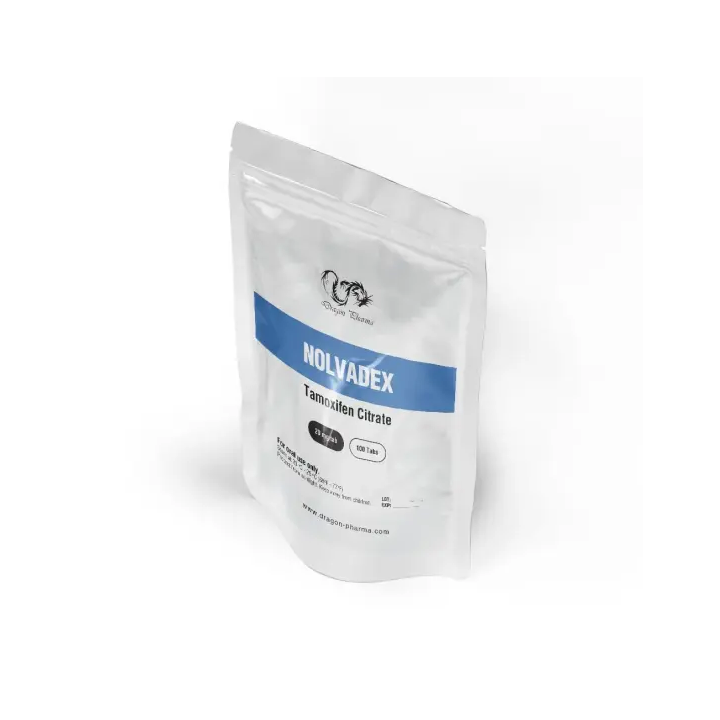
Nolvadex (Tamoxifen Citrate) is Dragon Pharma's formulation of the first-generation Selective Estrogen Receptor Modulator at 20mg per tablet — the most established SERM in post-cycle therapy, with decades of clinical data from breast cancer treatment providing a deeper pharmacological understanding than any other PCT compound. Tamoxifen is not simply an "estrogen blocker": it is a tissue-selective ERα modulator that is simultaneously antagonist in breast tissue and the HPG axis (producing its PCT and gynecomastia-preventive effects) and agonist in bone and other tissues — with much of its activity mediated not by Tamoxifen itself but by its significantly more potent active metabolite, Endoxifen.
Also searched as: Nolvadex 20mg, Tamoxifen Citrate, Nolvadex PCT, Tamoxifen anti-estrogen, Dragon Pharma Nolvadex.
What a SERM Is — The Tissue-Selective Mechanism
Understanding Tamoxifen requires understanding the SERM concept that most competitor content compresses to "blocks estrogen":
- Estrogen receptors (ERα and ERβ) are present in multiple tissues throughout the body. When estrogen binds to ERα, it triggers different downstream gene expression depending on the tissue — the receptor's conformation changes differently in different cell types, and the co-regulatory proteins that interact with the receptor complex vary by tissue
- Tamoxifen binds ERα with high affinity but induces a receptor conformation different from estradiol — this modified conformation acts as an antagonist in some tissues (blocking estrogen's effects) and as a partial agonist in others (producing some estrogen-like effects)
- In breast tissue: Tamoxifen is an ERα antagonist — it competes with estradiol for receptor binding and blocks estrogen-driven gene expression. This is the basis for its use in hormone receptor-positive breast cancer and for gynecomastia prevention in AAS users
- In bone tissue: Tamoxifen is an ERα agonist — it maintains bone mineral density, which is why Tamoxifen does not carry the bone loss risk that AIs (which eliminate estrogen entirely) produce with long-term use
- In the hypothalamus and pituitary: Tamoxifen is an ERα antagonist — it blocks the estrogen negative feedback signal, leading to increased GnRH, LH and FSH production. This is the PCT mechanism: by removing estrogen's suppressive signal on the HPG axis, Tamoxifen allows LH and FSH to rise and stimulate endogenous testosterone production
The Active Metabolites — Why Endoxifen Matters
This pharmacokinetic distinction is consistently omitted from competitor content:
- Tamoxifen is a prodrug that undergoes extensive hepatic metabolism. Its primary active metabolites are 4-hydroxytamoxifen (4-OHT) and Endoxifen — both produced through CYP2D6 enzymatic conversion
- 4-hydroxytamoxifen has approximately 30-100× higher affinity for ERα than Tamoxifen itself. Endoxifen has similar ERα affinity to 4-OHT and is present at much higher plasma concentrations — making Endoxifen the primary mediator of Tamoxifen's therapeutic effects
- CYP2D6 genetic polymorphism affects Tamoxifen's effectiveness — "poor metabolisers" (individuals with reduced CYP2D6 activity from genetic variants) convert significantly less Tamoxifen to Endoxifen, potentially reducing PCT effectiveness. This genetic variation in Tamoxifen metabolism is a real and clinically documented phenomenon
- The 14-day half-life of Endoxifen (vs Tamoxifen's 5-7 day parent half-life) means Tamoxifen's effects persist significantly beyond its own blood level — providing sustained ERα blockade even as Tamoxifen concentrations decline
Nolvadex vs Clomid — When to Choose Each
| Parameter |
Nolvadex (Tamoxifen) |
Clomid (Clomiphene) |
| Class |
SERM — pure estrogen receptor modulator |
SERM — mixed clomiphene isomers |
| Active mechanism |
Tamoxifen → Endoxifen (via CYP2D6); pure ERα modulation |
Enclomiphene (active) + zuclomiphene (partially estrogenic) isomers |
| Gynecomastia prevention |
Excellent — primary use case historically |
Good but less targeted for gyno specifically |
| LH/FSH stimulation |
Good — via HPG ERα blockade |
Strong — historically considered superior for LH rise |
| Side effect profile |
Milder vision effects; no mood disturbance in most |
Vision disturbances; potential mood effects from zuclomiphene |
| Bone density |
Protective (agonist in bone) |
Variable — depends on estrogenic vs anti-estrogenic balance |
| Common PCT role |
Solo or combined with Clomid; gyno prevention focus |
Solo or combined; LH stimulation focus |
| Anadrol gyno |
Preferred — blocks ER directly regardless of aromatisation |
Less effective for non-aromatising estrogenic compounds |
On-Cycle vs PCT Use
Tamoxifen has two distinct use contexts in AAS protocols:
- On-cycle gynecomastia prevention: 10-20mg/day during an AAS cycle to prevent estrogen-driven gynecomastia. Note that Tamoxifen does not reduce estrogen levels — it blocks ER in breast tissue — so estrogenic side effects other than gyno (water retention, mood effects) are not addressed. AI is the appropriate tool for systemic estrogen management; Tamoxifen is specifically for breast tissue ERα blockade
- PCT: 20-40mg/day after cycle completion to block HPG axis estrogen feedback and stimulate LH/FSH recovery — the standard SERM PCT mechanism
Effects and Benefits
- Gynecomastia prevention — ERα antagonism in breast tissue; the most established gyno prevention protocol
- HPG axis LH/FSH stimulation — ERα blockade at hypothalamus and pituitary removes estrogen negative feedback, allowing LH and FSH rise
- Endogenous testosterone restoration during PCT — downstream of LH/FSH recovery
- Bone density preservation — ERα agonism in bone; unlike AIs, does not contribute to bone loss with extended use
- Anadrol gynecomastia management — SERM-based protection effective against non-aromatase ER-mediated estrogenic effects from Oxymetholone
Dosage and Administration
| Protocol |
Dose |
Duration |
Notes |
| PCT (standard) |
40mg/day → 20mg/day |
Weeks 1-2 at 40mg; weeks 3-4 at 20mg |
Begin 2-3 weeks after last long-ester injection; 24-48h after last short ester |
| PCT (with Clomid) |
20mg/day Nolvadex + 50mg/day Clomid |
4-6 weeks |
Combination for heavier cycles |
| On-cycle gyno prevention |
10–20 mg/day |
Throughout cycle as needed |
Does not lower estrogen; add AI for systemic estrogen management |
At 20mg per tablet and 100 tabs per pack, a standard 4-week PCT (40mg/day weeks 1-2, 20mg/day weeks 3-4) uses 60 tablets — leaving 40 tablets as reserve. The long half-life of Tamoxifen's active metabolite Endoxifen means a missed dose has relatively minor impact on overall ERα blockade compared to shorter-acting compounds.


 Security policy
 Delivery policy
 Return policy



Comments (0)
Your review appreciation cannot be sent
Report comment
Report sent
Your report cannot be sent