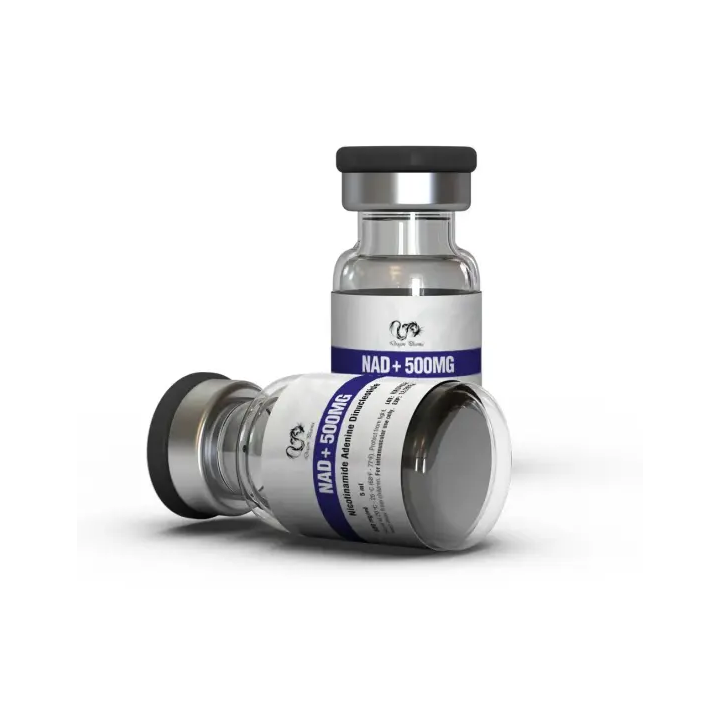
NAD+ 500mg — Injectable Nicotinamide Adenine Dinucleotide by Dragon Pharma
NAD+ (Nicotinamide Adenine Dinucleotide) is Dragon Pharma's injectable formulation of the fundamental cellular coenzyme at 500mg per vial — not a peptide or a hormone, but the most essential redox molecule in cellular metabolism, required as a substrate by sirtuins (epigenetic regulatory proteins), PARP (DNA repair enzymes), and the mitochondrial electron transport chain. NAD+ declines approximately 50% between ages 40-60 in most tissues. Injectable NAD+ delivers the coenzyme directly to systemic circulation, bypassing the metabolic conversion steps required by oral NAD+ precursors (NMN, NR).
Also searched as: NAD+ injection, injectable NAD, Nicotinamide Adenine Dinucleotide, NAD+ IV, NAD Dragon Pharma.
Why Injectable NAD+ Instead of Oral Precursors (NMN/NR)
Understanding why the injectable route matters requires understanding the pharmacokinetics of NAD+ supplementation:
- NAD+ itself is a large, charged molecule — it does not efficiently cross cell membranes or intestinal walls when taken orally. Oral NAD+ is substantially degraded in the gut before absorption and what reaches systemic circulation is minimal
- Oral NAD+ supplementation therefore uses precursors: NMN (Nicotinamide Mononucleotide) and NR (Nicotinamide Riboside) are smaller molecules that are absorbed orally and converted to NAD+ intracellularly. These are legitimate approaches but involve conversion steps, tissue-specific uptake efficiency, and significant inter-individual variability
- Injectable NAD+ bypasses all conversion steps — it delivers the final product (NAD+ itself) directly to systemic circulation. Tissues then take up NAD+ from blood and phosphorylate it intracellularly to the forms needed for metabolic function
- IV NAD+ administration (as used in clinical addiction and anti-aging protocols) produces rapid, measurable elevation of blood NAD+ levels and subjective effects (mental clarity, energy) within hours — effects that oral precursors take days to weeks to produce. Subcutaneous injection provides a middle ground between IV speed and convenience
The Three Key NAD+ Mechanisms
NAD+ is not a single-function molecule — it drives three distinct and critical cellular processes:
- 1. Sirtuins (SIRT1-7) — Epigenetic Regulation and Longevity
Sirtuins are a family of seven NAD+-dependent deacetylase enzymes that regulate gene expression by removing acetyl groups from histones and other proteins. They are central to: DNA repair, inflammation reduction, metabolic regulation, circadian rhythm maintenance, and cellular stress response. SIRT1 and SIRT3 are particularly active in response to caloric restriction and exercise — the same interventions that extend lifespan in animal models. All seven sirtuins require NAD+ as a co-substrate — they cannot function without it. As NAD+ declines with age, sirtuin activity falls correspondingly
- 2. PARP Enzymes — DNA Damage Response
PARP (Poly ADP-Ribose Polymerase) enzymes detect and repair DNA strand breaks — responding to the thousands of DNA damage events that occur in each cell daily. PARP enzymes consume NAD+ as their energy source during repair — each repair cycle depletes cellular NAD+ significantly. With aging and increasing oxidative stress (including from intense exercise and AAS use), PARP is activated more frequently, consuming more NAD+ and contributing to NAD+ depletion. Providing NAD+ directly supports PARP's ability to sustain DNA repair without depleting the cellular NAD+ pool for other functions
- 3. Electron Transport Chain — Mitochondrial Energy Production
NAD+ is the primary electron carrier in mitochondrial energy production — in its reduced form (NADH), it carries electrons to Complex I of the electron transport chain, driving ATP synthesis. The NAD+/NADH ratio is a fundamental regulator of metabolic rate and mitochondrial efficiency. Elevating the NAD+ pool shifts the NAD+/NADH ratio toward oxidised NAD+, favouring increased mitochondrial activity, fatty acid oxidation and energy production
CD38 — The NAD+ Destroyer That Increases With Age
A specific mechanism that most competitor content omits entirely:
- CD38 is an enzyme that is the primary consumer of NAD+ in aged tissues — it is an NADase (NAD-consuming enzyme) expressed on immune cells and other tissues
- CD38 expression increases dramatically with age and inflammation — it is upregulated by the same inflammatory signals that characterise the "inflammaging" phenomenon of aging
- In aged mice, CD38 knockout (removing CD38) prevents age-related NAD+ decline and maintains sirtuin activity at youthful levels — confirming CD38 as the primary driver of age-related NAD+ depletion
- For practical supplementation: the same factors that elevate CD38 (inflammation, oxidative stress) are present during intense AAS cycles. Providing injectable NAD+ directly replenishes the pool that CD38 is consuming — a continuous resupply strategy against the NAD+-destroying enzyme
NAD+ and Exercise — The AAS Context
The performance-specific relevance of NAD+ supplementation:
- Intense exercise — particularly eccentric loading and muscle damage — produces significant oxidative stress that activates PARP, consuming NAD+. Post-exercise cellular NAD+ depletion is measurable and recovery of NAD+ levels takes 12-48 hours
- AAS cycles, particularly those involving high training volumes and the additional oxidative stress of 17-AA oral compounds, place above-average PARP activation demand on cells — accelerating NAD+ consumption
- Sirtuin activity during recovery is NAD+-dependent — SIRT1 and SIRT3 are involved in the muscular adaptation response to exercise and the mitochondrial biogenesis that follows training. Maintaining NAD+ levels supports this adaptation process
- NAD+ infusions are used clinically in post-operative recovery contexts to support cellular energy production during healing — the same principle applies to post-training or post-competition recovery
Effects and Benefits
- Direct NAD+ delivery — bypasses oral precursor conversion variability; immediate systemic elevation
- Sirtuin activation — all seven sirtuins are NAD+-dependent; elevated NAD+ restores sirtuin function toward youthful activity levels
- DNA repair support — PARP enzyme function is sustained without depleting the cellular NAD+ pool
- Mitochondrial energy production enhancement — improved NAD+/NADH ratio supports electron transport chain efficiency
- Mental clarity and energy — rapid subjective effects after IV/subcutaneous administration; reported consistently in clinical NAD+ infusion data
- No testosterone suppression — no PCT required
Dosage and Administration
| Protocol |
Dose |
Route |
Frequency |
| Recovery / acute support |
250–500 mg |
Subcutaneous or slow IV |
Daily for 3–5 days; then weekly maintenance |
| Longevity maintenance |
250 mg |
Subcutaneous |
Weekly or biweekly |
At 500mg per vial, one full vial is an acute dose; 250mg (half vial) for maintenance. IV administration produces the fastest and most pronounced effects but requires appropriate clinical setting and slow infusion (nausea, flushing and chest tightness are common with fast IV NAD+ — always infuse slowly over 1-2 hours if given IV). Subcutaneous injection is safer and more practical for self-administration. Reconstitute with bacteriostatic water. Store reconstituted vial refrigerated at 2-8°C for up to 28 days.


 Security policy
 Delivery policy
 Return policy
Comments (0)
Your review appreciation cannot be sent
Report comment
Report sent
Your report cannot be sent